
Saturday, February 11, 2017
Mt Ruapehu (Turoa)
Camila and I took a road trip last weekend to Mt Ruapehu in the center of the North Island. The mountain peaks at just under 2,800 meters. We stayed a night in Ohakune and the next morning I rode the southern side up to Turoa ski field.


Thursday, June 9, 2016
Mt Taranaki
Mt Taranaki has also been on my bucket list for several years. After two days on the Forgotten World Highway we spent Sunday night in New Plymouth. I got up early on Monday morning (it was a long holiday weekend) and drove 50km south to Stratford to climb the access road to the ski field.

Its not a big climb by world standards, although it is by Auckland standards. The elevation gain is approx 700 meters with the gradient starting at 1-2% and gradually increasing to 8-9%. It was also cold; only 1-2 degrees celsius.

Its not a big climb by world standards, although it is by Auckland standards. The elevation gain is approx 700 meters with the gradient starting at 1-2% and gradually increasing to 8-9%. It was also cold; only 1-2 degrees celsius.
Wednesday, June 8, 2016
Forgotten World Highway: Day 2
Day 2 of the FWH was a 60km ride from Wangamomona to Stratford. Although we awoke to fog, it completely disappeared and turned to a stunning day once we crested the first pass.

Our hotel at the end of day-1 was not ideal for post-ride recovery. Not only did our room not have wifi or a TV, but the bathrooms and showers were shared! You can see a few photos below of the hotel and Whangamomona followed by the westward ride to Stratford.

Our hotel at the end of day-1 was not ideal for post-ride recovery. Not only did our room not have wifi or a TV, but the bathrooms and showers were shared! You can see a few photos below of the hotel and Whangamomona followed by the westward ride to Stratford.
Tuesday, June 7, 2016
Forgotten World Highway: Day 1
FWH has been on my bucket list for 4 years. I first read about FWH in Cycling Tips in 2012. Finally, I had the chance to ride it this past Queen's Birthday Weekend with Camila.

We chose to break the ride into two days. Day 1 was a 90km ride from Taumaranui to Wangamomona. Day 2 was an easier 60km ride to Stratford at the foot of Mt Taranaki. Traveling west gave us the benefit of a slight tail wind, and a night in New Plymouth.

We chose to break the ride into two days. Day 1 was a 90km ride from Taumaranui to Wangamomona. Day 2 was an easier 60km ride to Stratford at the foot of Mt Taranaki. Traveling west gave us the benefit of a slight tail wind, and a night in New Plymouth.
Saturday, January 23, 2016

Saturday, January 16, 2016

Friday, January 8, 2016
Medellin!
Camila and I were back in Medellin for the last 3 weeks. It was great to be back. I did a few rides but unfortunately I don't have the form for big rides like I did back in 2011. The riding was awesome nevertheless.


Sunday, May 31, 2015
Hit & Run
UPDATE (25 November 2015): Sam Ralph of Taupaki, Auckland was charged, convicted and sentenced to 9 months home detention for 1) Assault with a blunt instrument (vehicle), and 2) Failure to stop and ascertain injury (hit and run). He also spent 2 months in police custody awaiting trial on domestic violence charges. Good riddance to him.
Details of sentencing are below.
************
Its been well over 6 months since I last blogged. I had a decent summer of training (although I didn't race), and I was just settling into an autumn training schedule when I was hit by a car 2 weeks ago.

7.45am on Sunday May 17, 2015. I was riding with 5 others from Rangitoto Rockets on a quiet country road in Taupaki. We were riding at 35-40kph on a 2-lane road that is flat and straight. Suddenly I heard a car's brakes lock-up immediately behind us. Thats very strange, I thought; there is no oncoming traffic. Within a couple of seconds the driver accelerated and pulled up next to me with about 50cm between us and the passenger window down. (The six of us were riding two abreast and I was at the front-right position). The driver shouted out "Get off the fuckin' road" at me. Within a split second he accelerated again but very suddenly swerved to the left. Although it all happened within a second or two, it very much felt like everything was moving in slow motion at the time. His ute and worktray were coming my way and I quickly realised that I had nowhere to go.
Details of sentencing are below.
************
Its been well over 6 months since I last blogged. I had a decent summer of training (although I didn't race), and I was just settling into an autumn training schedule when I was hit by a car 2 weeks ago.

7.45am on Sunday May 17, 2015. I was riding with 5 others from Rangitoto Rockets on a quiet country road in Taupaki. We were riding at 35-40kph on a 2-lane road that is flat and straight. Suddenly I heard a car's brakes lock-up immediately behind us. Thats very strange, I thought; there is no oncoming traffic. Within a couple of seconds the driver accelerated and pulled up next to me with about 50cm between us and the passenger window down. (The six of us were riding two abreast and I was at the front-right position). The driver shouted out "Get off the fuckin' road" at me. Within a split second he accelerated again but very suddenly swerved to the left. Although it all happened within a second or two, it very much felt like everything was moving in slow motion at the time. His ute and worktray were coming my way and I quickly realised that I had nowhere to go.
Sunday, November 9, 2014
Starting from Zero
I started training for my 2014-15 racing season this week. Unfortunately, I have not been able to train properly for the last 3-4 months due to a combination of work (launched a peer-to-peer lending platform - Harmoney.com - in August), man-flu, bad weather in September, and minor surgery in October.
I was back into training last weekend once the doctor gave me the green light. But I really was starting from zero (power curve in black).
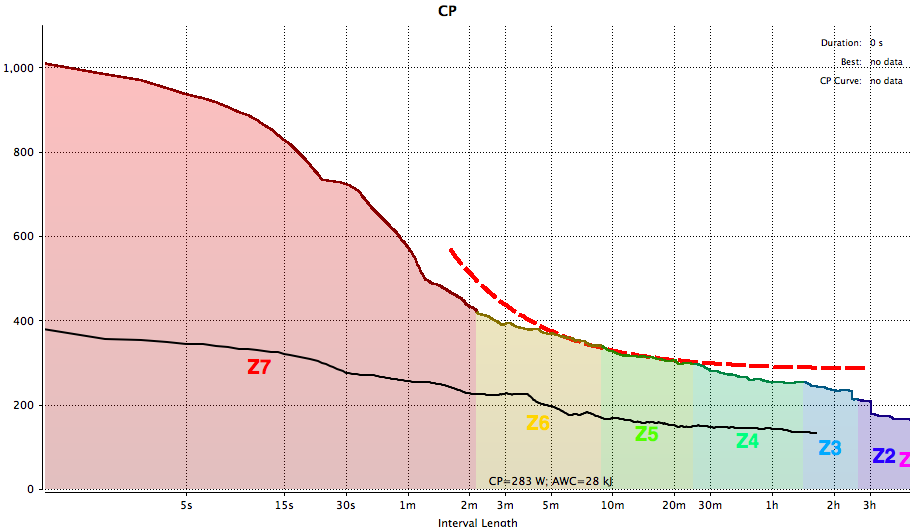
I was back into training last weekend once the doctor gave me the green light. But I really was starting from zero (power curve in black).
Sunday, June 15, 2014
2013-2014 Performance Review
A quick look-back at my power data and peak performance over
the 2013-2014 season:
The following is my power curve since early September. As we
all know I cannot sprint; my peak is just over 1,000 watts. Power drops off
sharply but flattens considerably after 2 minutes. The data demonstrates that
over longer duration efforts (3+ minutes), I have good strength and endurance.

Monday, June 2, 2014

Sunday, May 25, 2014

Tuesday, May 13, 2014
2013-2014 Season Review
Its now early May and my 2013-2014 season has drawn to a close. Although I had a great summer of riding, I wasn't able to race as much as I wanted to.
My racing season was split into two time periods: 3 races in November of 2013, and then a series of club races and the Auckland champs in March and April of 2014.
The first two races in November didn't quite go as planned. K1's start split the group as we merged with another field who started earlier than us. And the following week, I got severe cramps early in Bike the Bridge. The month ended with a strong result (12th overall) at the Northland Club Champs.
My racing season was split into two time periods: 3 races in November of 2013, and then a series of club races and the Auckland champs in March and April of 2014.
The first two races in November didn't quite go as planned. K1's start split the group as we merged with another field who started earlier than us. And the following week, I got severe cramps early in Bike the Bridge. The month ended with a strong result (12th overall) at the Northland Club Champs.
Saturday, April 12, 2014
Race Report: Auckland Club Champs
I finished 3rd in my age group at today's Auckland Club Champs. The field was small but select. The course was tough with power climbs and several long and sharp step-climbs.

Saturday, March 15, 2014
Training Camp: Italy 2010

Monday, February 3, 2014

Friday, January 31, 2014

Saturday, January 11, 2014
What Two Weeks of Rest Will Do
My chronic training load (blue line) decreased from 113 to 81 (it started at 0 in early September). My training stress balance (green line) moved from -42 to +60.

Wednesday, January 8, 2014
Mid-season Performance Review
Camila and I are in Bali, Indonesia for 10 days over the New Years break. I thought I would look at my performance improvement so far this season.
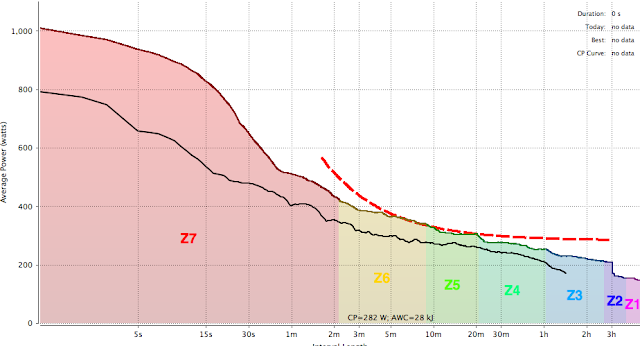
I bought my power meter in early September so I now have almost 4 months of training data, including 3 races in November. You can see in the chart above that my max output was 1,011 watts. The wattage drops off quickly until approximately 3 minutes but declines at a very slow rate thereafter.

I bought my power meter in early September so I now have almost 4 months of training data, including 3 races in November. You can see in the chart above that my max output was 1,011 watts. The wattage drops off quickly until approximately 3 minutes but declines at a very slow rate thereafter.
Friday, December 27, 2013

Sunday, November 17, 2013
Race Report: Fred Ogle Classic 2013
I had a great race this morning at the Fred Ogle Classic near Whangarei, finishing 12th overall. The course was 110km just west of Whangarei and covered some of the Tour of Northland stage-1 course. The race doubled as the Northland Club Champs and it drew a serious field, including semi-pros just back from the Tour of Southland.

After last week's implosion at MS Bike the Bridge, I wasn't sure how I would feel today. I did 4 rides this week - all pretty easy, just to make sure I was recovered.

After last week's implosion at MS Bike the Bridge, I wasn't sure how I would feel today. I did 4 rides this week - all pretty easy, just to make sure I was recovered.
Sunday, November 10, 2013
Race Report: MS Bike The Bridge 2013
I finished 15th today (of 648) in the MS Bike the Bridge, and 3rd in my age category. The course is 103km starting in Auckland city. The race begins by crossing the Auckland Harbor Bridge to the North Shore. The bridge closes for 3-4 events each year, such as the half-Ironman and Auckland Marathon.

Anyway, today's race was probably the hardest race I've done. The course has about a dozen climbs of around 100m, plus several smaller climbs. I was cramping badly by the 40th km. Usually that doesn't happen until 90-100km.

Anyway, today's race was probably the hardest race I've done. The course has about a dozen climbs of around 100m, plus several smaller climbs. I was cramping badly by the 40th km. Usually that doesn't happen until 90-100km.
Saturday, November 2, 2013
Race Report: K1 2013
I finished 2nd in my 35-44yrs age group yesterday, and 27th overall in the K1 90km race from Thames to Whitianga.

Until two months ago, I was training for the K2 200km race. My training was going well through August, and I was riding 4.5 hr rides by the end of the month. However, we had 5-6 weeks of terrible weather which put an end to my K2 goal.

Until two months ago, I was training for the K2 200km race. My training was going well through August, and I was riding 4.5 hr rides by the end of the month. However, we had 5-6 weeks of terrible weather which put an end to my K2 goal.
Sunday, September 22, 2013
Power Profile Test
I did the Power Profile test today with my new power meter. The goal of the test is to determine your strengths and weaknesses. The test is conducted by doing intervals over 15 seconds, 1 minute, and 5 minute intervals, as well as my functional threshold results.

The results of the power profile test shed insight on whether you're an: a) all rounder, b) sprinter, c) time-trialist, climber or steady-state rider, or d) pursuiter. I was under no illusion; I am definitely not a, b, or d.

The results of the power profile test shed insight on whether you're an: a) all rounder, b) sprinter, c) time-trialist, climber or steady-state rider, or d) pursuiter. I was under no illusion; I am definitely not a, b, or d.
Tuesday, September 17, 2013
FTP Test
I rode a functional threshold power test last week. I was quite surprised with my result: I averaged 261 watts over the 20 minute test. Not bad given where I am at - 6 months without any speed-work and just several weeks into base training.

The FTP sets my benchmark for training over the next few months. I'll be trying to improve my baseline with interval training, fast group rides, and hill work.

The FTP sets my benchmark for training over the next few months. I'll be trying to improve my baseline with interval training, fast group rides, and hill work.
Monday, September 9, 2013
Training with Power
I bought a Power2Max power meter last week. After training hard for the last couple of race seasons, I figured the next logical step was to use objective performance data to improve my training and racing.

Earlier this winter, I spent several weeks researching a range of brands. In the end I chose Power2Max because: 1) it has great user reviews, 2) is reasonably priced, and 3) can be used with training and racing wheels since it is a crank-based power meter.

Earlier this winter, I spent several weeks researching a range of brands. In the end I chose Power2Max because: 1) it has great user reviews, 2) is reasonably priced, and 3) can be used with training and racing wheels since it is a crank-based power meter.
Saturday, August 31, 2013
K2 Training Plan
I have wanted to race in K2 for the past two years. In 2011, I missed the race because I ended up in Colombia. And last year, a combination of flu and bad weather left me with only a few weeks to train. This year, I am training specifically for K2.

K2 is a 200km road-race in an anti-clockwise direction around the Coromandel peninsula. The race features 7 major climbs with a total of 2,300 meters of elevation gain. The smallest climb is 145m and the biggest is 425m. But what makes K2 so grueling is the fact that its held so early in the race season - the first week of November.

K2 is a 200km road-race in an anti-clockwise direction around the Coromandel peninsula. The race features 7 major climbs with a total of 2,300 meters of elevation gain. The smallest climb is 145m and the biggest is 425m. But what makes K2 so grueling is the fact that its held so early in the race season - the first week of November.
Thursday, August 15, 2013

Tuesday, August 6, 2013
Auckland's Best Chinese Bakeries
I have been surveying local Chinese Bakeries recently. Typically, we'll stop-in at the end of a training ride. The sugars go down easy.

Auckland's North Shore has several Chinese Bakeries. (For some reason, I couldn't find any when we lived in the city). I have visited these establishments enough times to know which bakery consistently has the best cream donuts and chocolate roughs.

Auckland's North Shore has several Chinese Bakeries. (For some reason, I couldn't find any when we lived in the city). I have visited these establishments enough times to know which bakery consistently has the best cream donuts and chocolate roughs.
Friday, July 26, 2013
My 2013 Off-Season
I've decided to take a couple of weeks off the bike. We all learn sooner or later that you have to take a break between seasons. If not, then burn-out is a certainty, and you don't want that to happen in the middle of your race schedule.
Looking at my weekly Strava volumes, the last time I took a week off was eleven months ago, in late August 2012. I've had several low-volume weeks, but I was always getting at least one ride in.

I would like to compete in K2 in early November. Its a 200km race held very early in the race season. I plan to start my base period in early August, which will give me ~3 months of training. I think a break now is the wise decision, despite the perfect weather we've had in Auckland for the past week. And anyway, most of my friends are currently on their off-season rest too.
Looking at my weekly Strava volumes, the last time I took a week off was eleven months ago, in late August 2012. I've had several low-volume weeks, but I was always getting at least one ride in.

Sunday, July 21, 2013

Sunday, May 26, 2013
Auckland's Best Group Rides
Sunday Albany Bunch: The best group ride, by a country mile, is the Sunday 7am Albany bunch. Its an 80km ride that draws the strongest cyclists from all over greater Auckland, including pro-conti and conti riders. Typically, about 50 people show up. After a warm-up on the old highway that runs north to Silverdale, the hammer goes down on the flat country roads that travel west. Flats turn to undulating rollers on the run into Helensville, before a really tough 5km step-climb that blows the group apart every time.
We then have a 20 minute ride to Kumeu. Its a long slow descent, broken up by more undulations, and some of NZ's roughest chip roads (highway 16). Usually, we stop at a Chinese Bakery in Kumeu for a few minutes. Then comes the ride back to Albany on Ridge Road. Its a quiet country road featuring 15km of undulation, false flats, and several short, steep power-climbs. The Sunday 7am Albany bunch is guaranteed to give you the best training conditions, regardless of whether you are in base, strength, or peak phases.

We then have a 20 minute ride to Kumeu. Its a long slow descent, broken up by more undulations, and some of NZ's roughest chip roads (highway 16). Usually, we stop at a Chinese Bakery in Kumeu for a few minutes. Then comes the ride back to Albany on Ridge Road. Its a quiet country road featuring 15km of undulation, false flats, and several short, steep power-climbs. The Sunday 7am Albany bunch is guaranteed to give you the best training conditions, regardless of whether you are in base, strength, or peak phases.

Tuesday, May 7, 2013
RaceShape.com
RaceShape.com is a cool new website that analyses Strava KOM segments to produce a chart of rolling time gaps. The time gap shows where you gained and lost time relative to the KOM holder. The chart below is the Sunnyside Road KOM segment just outside Albany.

Green is the elevation profile. The horizontal pink line is me, and the blue line is the KOM holder. The difference between the blue and pink lines represents the time difference (measured in seconds on the 2nd y-axis) between us over the distance.

Green is the elevation profile. The horizontal pink line is me, and the blue line is the KOM holder. The difference between the blue and pink lines represents the time difference (measured in seconds on the 2nd y-axis) between us over the distance.
Friday, May 3, 2013
2013 Race Season: Looking Back; Looking Ahead
The 2013 racing season is now over for me. I planned to continue racing through April and May (mostly in local club races) but my last race was the Tour of Northland in March. Since then, moving into the city, a little burn-out, and other priorities kept me off the saddle most days of the week.
So, lets look back at my 2013 season. My best result and most exciting race was finishing 12th at Taranaki Cycle Challenge. I managed to make the break at kilometer 90 and hold on for the last 58km. The Tour of Northland was my first stage race and first time racing in the same field as pros. I learned a lot, and really enjoyed stage-racing. I'll definitely be back in 2014. The Tour de Ranges and The Rev were decent races. I finished in the first group on both undulating courses.
So, lets look back at my 2013 season. My best result and most exciting race was finishing 12th at Taranaki Cycle Challenge. I managed to make the break at kilometer 90 and hold on for the last 58km. The Tour of Northland was my first stage race and first time racing in the same field as pros. I learned a lot, and really enjoyed stage-racing. I'll definitely be back in 2014. The Tour de Ranges and The Rev were decent races. I finished in the first group on both undulating courses.
Thursday, April 18, 2013
Foto Del Dia: Tour de France, 1975
Eddy Merckx attacks on Stage 15 (Nice to Pra Loup) of the 1975 Tour de France.


Monday, March 25, 2013
White Mountains, New Hampshire Cycling Weekend (August 2010)
This is another video I made in late-2010. I spent a weekend with Peter Montero (a colleague at Fidelity Investments) in New Hampshire's White Mountains. On Day-1, we covered 180km over four notches, including Kinsman, Franconia, Crawford, and Bear, and then the Kancamagus Pass. On Day-2, we cycled the roads around Waterville Valley, many of which were unpaved.
Thursday, March 21, 2013
Riccione, Italy Cycling Trip (October 2010)
This is an old video I made 2 years ago. I spent a week at Hotel Dory in Riccione on Italy's Adriatic Coast in October 2010. The hotel is essentially "cyclists-only" in the spring and fall. The area is great for cycling as the further inland you ride, the bigger the climbs.
Sunday, March 17, 2013
Race Report: Stage 4 Tour of Northland
I opted not to race the final stage of the Tour. Rain poured down all night and all morning. With 8 stitches taken out of my arm 5 days ago, I could not afford to risk crashing again.
Given that this was the first rain that Northland has seen in about 2 months, it was an unfortunate and slightly disappointing end to the Tour. But best to play it safe and live to ride another day. (Plus, the road will have plenty of oil and grease patches).
I'll be back next year. Racing with pros and elites requires different tactics. You have to be riding in the first 20-30 wheels. Otherwise, you'll miss the breaks. I wasn't ready for it this year. But I gained good experience and I'll be wiser in 2014.
Camila and I had a great time up north. I was lucky to have her along with me, particularly as she was willing to tolerate me each day after racing.
Camila and I had a great time up north. I was lucky to have her along with me, particularly as she was willing to tolerate me each day after racing.
Saturday, March 16, 2013
Race Report: Stage 3 Tour of Northland
Stage 3's 88km route ran from Opononi to Paihia on the east coast. We faced fresh head and sidewinds on a mainly flat and undulating course.

As usual, an attack was launched within 30 seconds of the gun. Four guys stayed away for approx 40km before they were reeled back in. The lack of big climbs and the winds meant that most of the group stayed together.

As usual, an attack was launched within 30 seconds of the gun. Four guys stayed away for approx 40km before they were reeled back in. The lack of big climbs and the winds meant that most of the group stayed together.
Friday, March 15, 2013
Race Report: Stage 2 Tour of Northland
Today was a 82km stage from Dargaville to Opononi. My goal was to make up some of the time I lost yesterday by hanging on to a strong group.


Within a few minutes of the stage start, a small group of 3-4 attacked. And, over the next 20km a couple of other small groups managed to break-off. Unlike my typical “open” and “age-group” races, we would never see these elite riders again.
Thursday, March 14, 2013
Race Report: Stage 1 Tour of Northland
Stage 1 of the Tour of Northland travelled 92km from Whangarei, on the east coast, to Dargaville, on the west coast. There were about 70 entrants in my group, Group 1, comprising of pros and wanna-be's. (In total, the Tour has approx 400 entrants in self-selected groups).

About 10km into the race, our group split into three groups. I was surprised the attack happened so early and I expected us to re-group. We didn't. Ten or fifteen in my group tried to close a 20 second gap, but after about 10km it seemed we gave up. And then 20km later, we were caught by a group of another 15 or so.

About 10km into the race, our group split into three groups. I was surprised the attack happened so early and I expected us to re-group. We didn't. Ten or fifteen in my group tried to close a 20 second gap, but after about 10km it seemed we gave up. And then 20km later, we were caught by a group of another 15 or so.
Sunday, March 10, 2013
Race Preview: Tour of Northland 2013
The Tour of Northland starts on Thursday morning. At this point, I'm assuming I can race, but I won't know for certain until I see the doctor again on Tuesday (my 6th visit).

TON is a four-day stage race starting in Whangarei, about 150km north of Auckland. Many friends have recommended TON as a fun, well-organized event.
Stages
Stage-1: 92km from Whangarei to Dargaville. Most notable is a 200 meter climb just out of Whangarei. The remainder of the stage undulates, with the exception of a 75 meter climb at km-60.

TON is a four-day stage race starting in Whangarei, about 150km north of Auckland. Many friends have recommended TON as a fun, well-organized event.
Stages
Stage-1: 92km from Whangarei to Dargaville. Most notable is a 200 meter climb just out of Whangarei. The remainder of the stage undulates, with the exception of a 75 meter climb at km-60.
Wednesday, March 6, 2013
Health Update
I've been off the bike since Sunday (today is Wednesday) with 8 stitches just below my right elbow. The doctor has said I can't ride until we see progress with the healing. Unfortunately, the area around my elbow was red and swollen yesterday, suggesting it may be infected, so the doctor took several stitches out to relieve the pressure.
I am still hopeful for the Tour of Northland, which starts in a week from tomorrow. But I probably won't know for certain until 2-3 days before the race starts.
Now, I am on complete rest. I rode for an hour yesterday on a stationary bike at the gym, but I won't repeat it as I think the sweating may risk infection. At best, I'll do a couple of very easy rides in the days just before Northland.
I'm quite disappointed as my training was focused on Northland. And there is still a chance I won't be in Northland at all. However, its a 4-day race, so hopefully I'll find my legs on day-1 and be competitive in the remaining stages.
I am still hopeful for the Tour of Northland, which starts in a week from tomorrow. But I probably won't know for certain until 2-3 days before the race starts.
Now, I am on complete rest. I rode for an hour yesterday on a stationary bike at the gym, but I won't repeat it as I think the sweating may risk infection. At best, I'll do a couple of very easy rides in the days just before Northland.
I'm quite disappointed as my training was focused on Northland. And there is still a chance I won't be in Northland at all. However, its a 4-day race, so hopefully I'll find my legs on day-1 and be competitive in the remaining stages.
Monday, March 4, 2013
Vo2 Max, Lactate Threshold, and Power Testing
I did a lab test at the Millennium Institute of Sport and Health last week. We are well into the 2013 race season so I thought it would be an opportune time to undergo testing and get real data on my Vo2 maximum, lactate threshold, and power output.

After a 10-minute warm-up on a stationary bicycle, the test starts with a 3-minute interval at 150 watts. The resistance is increased every 3 minutes by 30 watts until the point of failure. The stronger you are, the longer the test.

After a 10-minute warm-up on a stationary bicycle, the test starts with a 3-minute interval at 150 watts. The resistance is increased every 3 minutes by 30 watts until the point of failure. The stronger you are, the longer the test.
Sunday, March 3, 2013
Race Report: Pokeno 70km 2013
My luck ran out today. I crashed out of a 70km race while negotiating a tight right hand corner in pouring rain. Now I am at home nursing 8 stitches in my right elbow, road rash on both hips, and grazing on my chest and left elbow, as well as my right knee and shin.
The race was going quite well for me. I was in the leading group of 40 or so until km-10. Several pros opened up a 10 second gap leading into a 3km 7% climb. The field splintered but I was able to hang on to a 12-man group that trailed the pro group by ~20 seconds.
The race was going quite well for me. I was in the leading group of 40 or so until km-10. Several pros opened up a 10 second gap leading into a 3km 7% climb. The field splintered but I was able to hang on to a 12-man group that trailed the pro group by ~20 seconds.
Saturday, February 23, 2013
Race Report: The Rev 100 2013
I finished in 33rd place and in the leading bunch at today's race, The Rev 100, held in Cambridge, Waikato. We completed the 100.4km course in 2 hours and 37 minutes (38.3kph average).

The course has a steep 2.5km climb beginning at the 6km mark named French Pass. The double-digit gradient combined with the length splintered the field. I was in the first group of ~15 to crest and we were trailed by another group of 15-20. The two groups came together a couple of kilometers later and that is how we remained until the finish (luckily we left several hundred other cyclists behind us).

The course has a steep 2.5km climb beginning at the 6km mark named French Pass. The double-digit gradient combined with the length splintered the field. I was in the first group of ~15 to crest and we were trailed by another group of 15-20. The two groups came together a couple of kilometers later and that is how we remained until the finish (luckily we left several hundred other cyclists behind us).
Tuesday, February 19, 2013
Cycling in Colombia: My 5-Month Adventure & Alto de Letras
In October 2011, I flew to Medellin to spend two months cycling in Colombia. My primary goal was to climb Alto de Letras, Colombia's biggest mountain pass. But I found much more in Colombia and ended up staying for five months. This post is a short story about my adventure.
Date: 7.30am, February 16, 2012
Location: Mariquita, Colombia
Altitude: 492 meters
I was standing at the outskirts of a small town named Mariquita, located at the eastern foot of Colombia’s Andes Mountains. A 10% wall loomed in front of me, and that was just the beginning of an 80km climb that rises 3,800 vertical meters to a mountain pass named Alto de Letras.
I felt both excited and nervous about what lay ahead. All cyclists know the feeling – we all get it in the hours before an epic ride. Its part of the experience. Today would be the biggest climb of my life and it would complete my 8-month quest to cross the world’s greatest mountain passes.
But lets back up. How did I get to Colombia?
Tuesday, February 5, 2013

Monday, February 4, 2013
Best Food for Carbo Loading
Every endurance athlete has their favorite foods for pre-race carbo loading. A big plate of spaghetti bolognese was the tradition, and still is for many. But its not the only source of high-carbohydrate foods. So, which other foods will get you through a long race or a hard weekend of training?

Above is a chart ranking the carbohydrate content of various cooked foods, assuming a 100 gram portion. The data shows that white rice, pasta, and corn provide the most carbs.

Above is a chart ranking the carbohydrate content of various cooked foods, assuming a 100 gram portion. The data shows that white rice, pasta, and corn provide the most carbs.
Friday, January 25, 2013
Race Report: Mt Taranaki Cycle Challenge 2013
I finished 12th today out of 1,100 starters at the Mt Taranaki Cycle Challenge. I'm very happy with this result, particularly because I was a little disappointed with my race last weekend at Tour de Ranges. I finished with the leading group of 13 cyclists in 3hrs, 40mins and 59 seconds. We covered 147km at an average speed of 39.8kph.


I had not competed in this event before, so I wasn't sure what to expect this morning. From the course profile, the 148km route looked mostly flat to undulating. And, I didn't know who was going to show up: pros, former pros, almost pros, and pros-in-the-making.
Tuesday, January 22, 2013
Who Produces the Most PROs?
As you might expect, Italy supplies the most professional cyclists to the UCI's WorldTour this year; 66 to be exact. France, Belgium, and The Netherlands follow closely with 54, 53, and 51, WorldTour cyclists, respectively. But Italy and France also have relatively large populations. And Belgium and The Netherlands aren't too small either. So, which country produces the most PROs on a per capita basis?

Above is a chart based on UCI and Wikipedia data showing that Luxembourg produces the most PROs by quite a stretch once we look at the data on a per capita basis. Luxembourg's tiny population of just 500,000 sent 5 PROs to the WorldTour this year (10 PROs per million).

Friday, January 18, 2013
Race Report: SRAM Tour de Ranges 2013
Today was my first race since riding three cyclosportifs in France and Italy in 2011. I've been looking forward to this event for a while as the SRAM TdR is really the first race of the season.

I recon'd the ride with Camila 10 days ago, and after speaking with several friends who have raced this event previously, I was pretty sure I knew how the race would unfold. I was completely wrong.

I recon'd the ride with Camila 10 days ago, and after speaking with several friends who have raced this event previously, I was pretty sure I knew how the race would unfold. I was completely wrong.
Thursday, January 10, 2013
Recon Ride: SRAM Tour de Ranges
Today, I reconnoitered the SRAM Tour de Ranges route. The race is next Saturday, January 19th in the Hunua Ranges just south of Auckland. Camila and I drove to the start in Clevedon this morning and then I rode the 110km course.


Wednesday, December 26, 2012
Race Calendar: 2013 Summer Season
These are the five races on my race calendar for the 2013 summer season:
- SRAM Tour de Ranges, 110km, January 19
- Around Mt Taranaki, 150km, January 26
- The Rev, 142km, February 23
- Tour of Northland, 4 stages, 340km, March 14-17
- Taupo to Rotorua, 100km, April 6
In addition to the races above, several Auckland clubs host regular weekend races. Unfortunately, there are not as many road races near Auckland as I hoped. I would need to travel to Wellington or the South Island to add more races.
Sunday, December 23, 2012
Strava KOM Targets: Summer 2013
The following Strava segments are my targets for this summer (including current ranking and time):

I am also adding a Tamaki Drive time-trial from Mechanics Bay to Mission Bay. I ride the 4.7km at threshold, soft-pedal for 10 minutes, and then ride the return leg to Mechanics Bay, again at threshold. The course is 9.4km in total and I use this as my performance indicator. I rode the TT in June as I thought it would be useful to measure my off-season baseline. I completed the two legs in 14mins and 7secs, averaged 40.0kph, and averaged a heart rate of 180bpm. Strava calculated my average power at 296 watts. Now that we are approaching the racing season, I'll likely ride the TT monthly.
- Wright Road: 5th place (of 129); 7.39 mins
- Sunnyside Climb: 9th place (of 152); 5.07 mins
- Albany Hill: 16th place (of 219); 6.39 mins
- Helensville Climb: 29th (of 175); 12.39 mins
- Scenic Drive: 50th place (of 198); 31.24 mins

I am also adding a Tamaki Drive time-trial from Mechanics Bay to Mission Bay. I ride the 4.7km at threshold, soft-pedal for 10 minutes, and then ride the return leg to Mechanics Bay, again at threshold. The course is 9.4km in total and I use this as my performance indicator. I rode the TT in June as I thought it would be useful to measure my off-season baseline. I completed the two legs in 14mins and 7secs, averaged 40.0kph, and averaged a heart rate of 180bpm. Strava calculated my average power at 296 watts. Now that we are approaching the racing season, I'll likely ride the TT monthly.
Monday, December 17, 2012
Strava Multiple Ride Mapper
I found a Strava app that displays multiple rides on one map. It can be found here. Below are some screen-shots of my rides in France, Spain, Italy, Buenos Aires and northwest Argentina, Uruguay, Colombia, Turkey, Auckland, and Boston.
 |
| Medellin |
Thursday, November 29, 2012
Available Now: Switchback Cycling Team 2013 Kit
Switchback Cycling Team's 2013 kit is now available. The designs are below (jersey, bib shorts, vest, cap, socks, arm/knee/leg warmers, etc). Orders must be placed by December 14, 2012. Delivery will be February. Please email me to request an order form at: duncangross - at symbol - gmail dot com. (Or just leave a comment below with your email address).


Saturday, November 3, 2012
Colombian Arepas de Chocolo in Auckland
After six months back in Auckland, we finally found Arepas de Chocolo. These are a Colombian staple and can be found in every home, restaurant, cafe, convenience store, and supermercado.
Arepas de Chocolo are especially good for cyclists as they are 84% carbohydrate and just 17% sugar. You can read my original post about Colombian food and arepas here (published in October 2011).
We cooked up several arepas this morning and they were pretty close to the real thing. We are missing quesito but either cottage cheese or feta is a decent substitute.

Arepas de Chocolo are especially good for cyclists as they are 84% carbohydrate and just 17% sugar. You can read my original post about Colombian food and arepas here (published in October 2011).
We cooked up several arepas this morning and they were pretty close to the real thing. We are missing quesito but either cottage cheese or feta is a decent substitute.

Subscribe to:
Posts (Atom)