Friday, February 24, 2012

Las Palmas Time Trial

I time-trialled Las Palmas yesterday. Palmas is the standard by which serious Medellin cyclists are judged. My result of 46 minutes and 24 seconds was.... mediocre (996 VAM).


Las Palmas climbs 771 meters over 11.2km. It traverses Medellin's eastern slopes on the way to the airport and Bogota. Palmas is packed with cyclists early in the morning, especially on weekdays.

Friends of mine TT'd in 43 minutes. Last October, I TT'd Palmas in 46 minutes 53 seconds early in a 178km ride to El Penol and back. I only gave Palmas about 80-90% effort on that day and felt fine during the remaining 150+ km.

Thursday, February 23, 2012

What Makes Colombian Cycling So Unique? Part VI

This post is the sixth installment on Colombian cycling and its unique attributes. The topic today is Colombia's terrain. 


Europe's Alps, Dolomites, and Pyrenees protrude from the earth. They launch themselves skyward with sharp, jagged rock and vertical cliffs. Once you're above 2,000 meters, the landscape is closer to a moonscape. I saw plenty of snow on Col de la Bonnette in June. I even saw people skiing on Stelvio in August!

Wednesday, February 22, 2012

Jerico

Just a short post today. We spent the night in Pintada after an 8 hour drive from Cali. It was late afternoon by the time we reached Pintada, and it wasn't safe to cross the mountains at night on the way to Medellin. So, I took advantage of the opportunity today and rode up to Jerico. Several friends in Medellin had suggested the 22km climb over the past few months. Jerico is noted for its mid-teen gradients.  


The climb is very enjoyable. The road is quiet with very little traffic. I wasn't sure what to expect at the top, but the town of Jerico is quite impressive. Its an old colonial town with a lot of color.


Monday, February 20, 2012

Cali Velodrome

We drove to Cali this morning. Cali is Colombia's 3rd largest city and is located in the southwest, approximately 100km from the Pacific.


I was interested in visting Cali's velodrome; the Velódromo Alcides Nieto Patiño. Cali has hosted the World Cup eleven times since 1996. The most recent World Cup meet in Cali was held in December 2011. The next World Cup in Cali will be in 2014. (Many of the World Cup athletes raced in Medellin one week after the December 2011 World Cup. I wrote about it here).


Sunday, February 19, 2012

La Linea

Wow, La Linea was a struggle today. Altimetrias de Colombia describes La Linea as Colombia's Stelvio Pass, but it felt more like Col de Joux Plane, Col du Glandon, or Port de Bales. It was really tough.


La Linea is known as Colombia's "second most mythical climb." It is a 21km climb rising 1,706 vertical meters to reach the summit at 3,275 meters. The first half wasn't too hard. I took it easy for the first few kilometers to gauge how I was feeling 3 days post-Letras. Up until around the 10th kilometer, I was feeling strong so I pushed hard. But then the gradient changed. Most of the second half had gradients of 9%-11%. I started to crumble and struggled through the second half. I finished in 1 hour and 50 minutes with a VAM of 932 (1706 meters/1.83). I was pretty happy with that result considering my form.

Saturday, February 18, 2012

Live from Calarca

Well, I had not planned on riding La Linea this week, but it turns out that our hotel tonight in Calarca is just 2km from the foot of this legendary climb. Colombian ciclistas describe La Linea as Colombia's "second most mythical climb" after Letras. It is imposible for me to ignore this opportunity. We had planned a river rafting trip for tomorrow (click here for pictures), but common sense prevailed, so instead I'll subject myself to several hours of pain and suffering in the Andes. 


La Linea is a mountain pass between Calarca and Ibague approximately 100km south of Letras and also in the Los Nevados National Park. The more famous route over Alto de La Linea is from the west side, starting in Calarca. The climb is 22km and rises 1650 meters to an altitude of 3265 meters. I should complete the climb in about 2 hours. Depending on how I feel, and the weather, I'll descend to Ibague for the return trip. Climbing from east to west is a 1400 meter elevation gain over 23km. 


Thursday, February 16, 2012

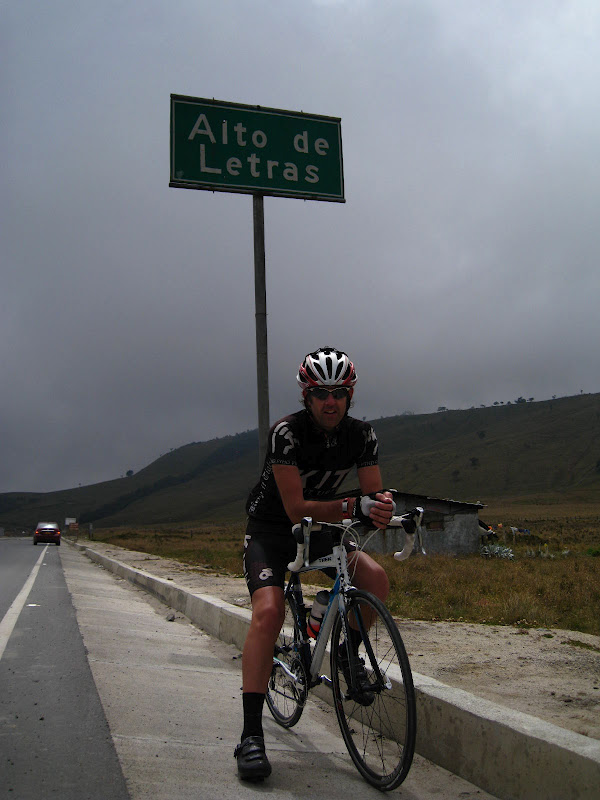
Letras 3704

I made it! Letras is the biggest mountain pass on this planet (by altitude gain), and Colombia's "most mythical climb." It was an awesome ride. I was pretty buggered by the last 500 meters, but at that point, who cares?! The altitude never seemed to directly affect me. A slight headache set in somewhere around the 3,000 meter point, but I am not sure if that was because of the thin air or something else.


The climb was really great. 80km is a long way, and we went through a dozen or so small towns/villages. We had plenty of sun at the start (730am) and for most of the day. There was a thick layer of cloud between ~2800 meters and 3400 meters. I could see the cloud for quite a while before we entered it, and I was worried that it would be rain. Luckily, it was dry all day.

Wednesday, February 15, 2012

Live from Mariquita

I just arrived in Mariquita after a 6-hour drive from Medellin. We're at 500 meters altitude so its much hotter down here (approx 35-38 degrees celsius) than up in Medellin.  I was expecting to see Letras looming over this small town, but it is out of sight.


I am nervous about my form for tomorrow. Lets say that my fitness for 'epic riding' was a '10' last August when I spent 9 days in the Pyrenees with Dave Andersen. After my 4-week break over the holidays, I was hoping to be a '7' by now. But in reality, I am more like a '4'. I had some good training rides, but it didn't quite 'come-together' for me. On the other hand, my weight is reasonable: 71kgs (157lbs). I was generally able to avoid ice-cream and empanadas over the last 3 weeks, except for the Super Bowl. 

Tuesday, February 14, 2012

Descent into Medellin

Las Palmas is probably the best climb out of Medellin. It travels towards the east, gaining 976 meters over 16km. This is a 12 minute video of the descent back down into Medellin. The starting elevation is 2,500 meters and ends at 1,530 meters. (A few raindrops cloud the lens in the last minute or so).


Wednesday, February 8, 2012

Titiribi

Just a few pictures below of yesterday's medium-length ride (105km) to Titiribi. This small town is southwest of Medellin. There is nothing special about the Titiribi, but the ride from Medellin is quite nice with a couple of decent climbs. 


Wednesday, February 1, 2012

San Jeronimo II

As I mentioned in yesterday's post regarding Letras, I planned to ride to San Jeronimo in the next couple of weeks. Well, I rode to San Jeronimo today and got my 2,900 meters of climbing. 


The route to SJ is much easier than the return. Essentially, you have  900 meter climb from Medellin to Alto de Boqueron followed by a 30km descent to the small town of SJ. You drop from 2500 meters to 750 meters over the 30km. Once you reach SJ, you've covered half of the distance but, in terms of climbing, you've done less than one third of the actual work. 

Tuesday, January 31, 2012

Letras Training Plan

I am planning to climb Letras in the third week of February. Alto de Letras is the world's biggest mountain pass (by elevation gain) that I am aware of. Letras has a total elevation gain of 3,187 meters. The climb starts at an altitude of ~600 meters in the town of Mariquita and ends at an altitude of 3,677 meters. (Five small descents account for the difference between gross and net elevation gain).  


Source: Altimetrias de Colombia


I mentioned above that Letras is the biggest mountain pass I know of. The volcano of Mauna Kea in Hawaii is bigger - it offers 4,203 meters of elevation gain. But, Mauna Kea is not a mountain pass. And, nothing in Europe comes close to Letras. The biggest climbs I found in Europe were Gavia and Stelvio in the Dolomites, with almost 2,000 meters of elevation gain. The mountain passes in northern India and Chile are at higher altitudes (almost 5,000 meters) but the climbs (as measured from the nearby valleys) are only 2,000 meters or so. 

Monday, January 30, 2012

The Disappearing Watch

Watches were common on a cyclist's wrist for much of the 20th century. A stage winner wanted to know the time gaps over his opponents, but more likely, were provided by publicity-hungry sponsors. 


Watches first appeared in the 1950s but their popularity seemed to fade during the 1980s and 1990s. They could be seen on the rare occasion worn by Fignon in 1992 and Ullrich in 1997. The watch was barely seen again until Lance wore one in the 2004 TDF.


Monday, January 23, 2012

Is Cocaine a Performance Enhancing Drug?

Well, I am in Colombia (still) and cycling (barely - I took a month off and now I am suffering mightily). Several years ago I read an article on the Internet discussing the use of cocaine and performance enhancing drugs in professional cycling. Since Colombia is the world's leading supplier of cocaine, I thought I would do some research. 


Before we get into the results of several scientific studies, here is a brief history of performance enhancing drugs in professional cycling: 

Tuesday, January 17, 2012

Weekend at the Finca

A 'Finca' is a country farm. My friend, Mauricio, invited me to his family's finca for the weekend, along with his wife, Tatiana, and Camila. The finca is located in an area south of Medellin that is perfect for cycling. We rode Saturday (to Marsella) and Sunday (to Valparaiso). For both of us, it was our first rides after the holiday break. We weren't feeling too strong, but we still managed a couple of 1,000 meter climbs. 


The best part about the Finca was the fact that we were far from Medellin. The roads were quiet and the scenery was spectacular. The rides were not long, by any measure, but we logged some decent kilometers for January. 

Friday, January 13, 2012

Matasanos (Climb to Don Matias)

I finally kicked off the 2012 season this week. Wednesday was an easy ride up Las Palmas, but today I climbed Matasanos with Gustavo Duncan of Altimetrias de Colombia.


The name, Duncan, is a coincidence. As you might guess, there are not many Duncans in Latin America. Gustavo told me that one of his ancestors was originally from the United Kingdom. Many UK'ers made their way to the Caribbean in the 1700s and 1800s. At some point, likely in the early 1800s, some of these immigrants traded weapons for land with Simon Bolivar. And thus, there are Latinos in Colombia and Venezuela today with fairly common Anglo names.


Thursday, January 5, 2012

Bring Back Oakley Factory Pilots

God Bless Factory Pilots. Sleek, functional, and intimidating.

Please leave a comment below if you will support a petition asking Oakley to reintroduce their 1988 Factory Pilot. 

Monday, December 19, 2011

The Importance of Good Hair

It was all about the hair. No doubt. In the old days, sponsors wanted their cyclists to look good, on and off the bike. 


Louis Bobet


Hugo Koblet, below, was known for carrying a comb in his jersey pocket. Just prior to the finish line, he would comb his hair to look good for the girls and the cameras.

Tuesday, December 13, 2011

Ciclovia Medellin

Medellin is one of several Latin American cities that hosts a weekly Ciclovia. Every Sunday from 9am to 1pm, Medellin closes 30km of main roads to vehicles. The roads are dedicated to cycling and other forms of recreational use, including walking, jogging, and rollerblading. 


Ciclovia Medellin began in 1989. Back then, only a few kilometers were allocated by the city; all on the city outskirts. Now, Ciclovia runs along the river and through the city center and upscale neighborhoods of Poblado and Envigado. Its the equivalent of shutting down Auckland's Queen St and Tamaki Drive, or, Boston's Newbury St, Storrow Drive and Atlantic Avenue.

Monday, December 12, 2011

The Grand Snail of the Velodrome

Medellin hosted 3 nights of track racing at the Martin Rodriguez ('Cochise') velodrome in Estadio, Medellin. The event is named Gran Caracol de Pista, which translates to The Grand Snail of the Track (I don't know why its called this, except the lead sponsor is a media company named Caracol). The Grand Snail was held one week after the World Cup in Cali (in southern Colombia), so many athletes from around the world were still here to participate. The biggest 'estrella' was Maximilian Levy of Germany. Other countries included France, Switzerland, Poland, and Malaysia along with most of Latin America.


Friday, December 9, 2011

What Makes Colombian Cycling So Unique? Part V

During my first two weeks here, I rode into the mountains on the other side of Medellin. A few days later, a Colombian friend asked about my route across the city. I didn't realize at the time, but I had chosen a road that borders the neighborhood of San Javier. When you think of Medellin as the murder capital of the world (which it was in the 1980s and 1990s), you shouldn't think of Medellin. You should think of San Javier.


This post is about Medellin's violent past. Its not directly related to cycling, but its important that visting cyclists, or any tourist for that matter, be aware of the neighborhoods they enter. A Garmin device or wrong turn can easily route you through one Medellin's dangerous barrios.


Medellin has long been a violent city. In the 1980s, Pablo Escobar's Medellin drug cartel fought an urban war to control the city. They eliminated competing cartels, bribed government officials, and offered rewards for the killing of police officers. Escobar himself was killed by the Colombian government in 1993 after a year-long manhunt. At its peak in 1991, Medellin's murder rate stood at 381 murders per 100,000 people. And the absolute number for the year: 6,500. (The UN's marker for an 'epidemic' murder rate is 10 per 100,000).  

Monday, December 5, 2011

What Makes Colombian Cycling So Unique? Part IV

Carry a rain jacket when cycling in Medellin. I learned my lesson shortly after arriving in October. 


Medellin is known as 'La Ciudad de la Eterna Primavera' or 'City of Eternal Spring.' The average temperature here of 22C (72F) remains constant throughout the year with only minimal variations (Colombia sits just above the equator). But it can be very wet here. Medellin's tropical rainforest climate averages 224 rain days per year. The months with the highest number of rain days are April and May, as well as September, October, and November (see chart below). 


Source: Instituto de Hidrologia Meteorologia y Estudios Ambientales.


However, my Colombian cycling friends tell me that rainfall in the last couple of years has been much higher than normal. They attribute this to El Nino, with Medellin experiencing unusually high rainfall every 4-5 years. In late 2010, dozens of people living on the slopes of Medellin were buried by mudslides.

Saturday, December 3, 2011

A Colombian Wedding and Cycling

My friend, Camila, invited me to a Colombian wedding. Her high-school friend, Paula, married Alejandro in Medellin last night. I wouldn't normally post about weddings, but a fairly serious Trek Madone and Pinarello riding cyclist was sitting at our table. We spent at least 15 minutes discussing routes, hardware, and VAM, so I guess the wedding now qualifies for my blog.


Wednesday, November 30, 2011

Quebrada de Las Conchas, Argentina

This is a video of my MTB ride with Matias, Gonzalo, and Javier from Cafayate to Cabra Corral. The ride took us through 80km of Quebrada de Las Conchas. 


If you saw the photos in my post here, you'll love the video. Most of the footage was shot just prior to sunset, so the picture is a little darker than usual. We rode until after dark, around 8.15pm.


The soundtrack is a little unclear, but I think the singer is saying something about Tony Danza.

Monday, November 28, 2011

The Switchback

A switchback, also known as a hairpin bend, is a sharp turn on a mountain road. Engineers use switchbacks to give vehicles the ability to ascend and descend a mountain by traversing it, rather than going up or down a prohibitively steep slope. And, constructing a road of switchbacks on either side of a mountain is far more economical than drilling a tunnel.

The 21 switchbacks of Alpe D'Huez.

I found surprisingly little information on the Internet about the history of switchbacks. Some of Europe's mountain passes were cleared thousands of years ago. Great Saint Bernard Pass in Switzerland is the oldest pass in the western Alps, with surviving traces of a Roman road. Today's road may not follow the original road, so I don't know if switchbacks were used by the Romans. However, many Roman roads were built to support military campaigns and transport heavy equipment, so I would suspect that switchbacks were used.


Sunday, November 27, 2011

What Makes Colombian Cycling So Unique? Part III

I am back in Medellin after two superb weeks in Argentina. Its been a month or so since I wrote about Colombian cycling, so today I am writing the third installment: Support Vehicles. You can read Part I here (The Colombians and Colombia's Road Surfaces) and Part II here (Food and Diet).


Colombian cyclists often arrange a support vehicle for long rides. The support vehicle serves three purposes: 1) to carry spare wheels and fix any mechanical problems, 2) to hand-out food and liquids, and 3) for safety (by trailing us if the traffic is heavy). A support vehicle is just like having a team-car, but without the sponsors' logos. 


If we're a small group (say 3-4) we'll have one motorcycle. With larger groups, say 12 or so, we'll have a motorcycle and at least one SUV. Usually, the driver is an ex-cyclist and bike mechanic. We often have Jorge accompany us (Jorge goes by the nickname 'Sapuca'). Sapuca is a former track-cyclist and very agile on his motorbike.

Sunday, November 20, 2011

ARG by MTB Day 4: Cafayate to Cabra Corral

Another awesome day in Argentina! We started at midday with a tour of the Michel Torino vineyard (where our hotel was located). After downing several tasting glasses of white and red wines, I was ready to ride. 


We spent the last 2 days riding south. Today we took Route 68 northeast back towards Salta, where we landed on Wednesday morning. 


An hour or so into the ride, we entered Quebrada de las Conchas, which is another amazing valley of unreal red rock formations. Route 68 winds its way through the Conchas valley, following an almost dry river bed.


Saturday, November 19, 2011

ARG by MTB Day 3: Molinos to Cafayate

Today was by far the best riding we've had in Argentina. The scenery was truly spectacular, as you'll see below! 


My day started at 9am. I went to the hotel dining room and was shocked to see two of my Argentine friends finishing their breakfast! I cannot believe an Argentine would be up so early. In fact, I am convinced they stayed up all night. 


Friday, November 18, 2011

ARG by MTB Day 2: Cachi to Molinos

Today we started cycling at the 'prompt' Argentine time of 3pm. I thought we were under the gun considering we had a 60km ride to Molinos, and all of it was on a windy, undulating, gravel road.


Thursday, November 17, 2011

ARG by MTB Day 1: Salta to Cachi

Today, we started our 5 day MTB trip in northwest Argentina. We are four: Matias Hodara, Gonzalo Chernitsky, Javier Vilamowski, and myself. Flights were dicey in Buenos Aires this morning. Just 5 minutes before we were due to board at 6.30am, all flights out of BA were put on hold due to volcanic ash from Chile. I knew about problems in the south west, but I wasn't aware of ash reaching the east coast of South America. Not knowing whether we would be waiting hours or days for flights to resume, all we could do was take a seat. The Argentines didn't seem too stressed, but I was quite worried (perhaps another sign that I over-stayed in the US). Luckily, flights were taking off again within a couple of hours. It all seemed very odd. 


Tuesday, November 15, 2011

Buenos Aires

On Thursday of last week, I borrowed Matias' hybrid and rode the 35km into Buenos Aires from the suburb of Tigre. BA is perfectly flat, so it was a pretty easy ride. The weather was great and the traffic was easily manageable (despite what I read online). And, just as my Colombian friends had warned me, Buenos Aires is the nicest European city I have seen.


Sunday, November 13, 2011

Uruguay!

I've been staying with my friend, Matias Hodara, and his family in Buenos Aires for the past few days. Yesterday, we conceived a plan to take the boat from Buenos Aires across the Rio de la Plata to Uruguay, ride 80km from Colonia to Carmelo, and then return by boat to Tigre (near Matias' house). We were three: Matias, his friend, Gonzalo Chernitsky, and myself, plus mountain bikes. It would be a good test - the three of us (and a fourth) will be riding together for 5 days in northwest Argentina next weekend.

Monday, November 7, 2011

Interview with Colombian Cyclist, Mauricio Leyva (Part II)

This is the second part of a two-part interview with Colombian cyclist, Mauricio Leyva. You can read Part I here.


Switchback Publications: Now lets talk about Medellin. I have been here about a month and I love this city. What do you like most about Medellin?


Mauricio Leyva: I like the weather, the girls - my wife is from Medellin - and the people are very nice and friendly. 


And the family. In Medellin, the family is very important; its the nucleus of society. And in the family, the most important person is the mother. So whats really nice in Medellin is the values and the culture. 


SP: As I mentioned, I've been here about a month. I find Medellin a very peaceful, calm city. But it wasn't always like that. Back in the 1980s, Medellin was a very different place. It was violent and unsafe. What was Medellin like for you in the 1980s?


Sunday, November 6, 2011

Fun in the Barrio: Clasico El Colombiano Urban Downhill

Every year, the local newspaper, El Colombiano, hosts 5 days of various cycling races in Medellin. The event is called Clasico El Colombiano and the races include a time-trial, road circuit, downhill urban, BMX, gravity, and mountain biking.


I spent a couple of hours watching the downhill urban this afternoon. Its similar to this event in Valparaiso, Chile, although today's course was not quite as suicidal, unfortunately.

Saturday, November 5, 2011

Argentina!

Tuesday I fly to Buenos Aires. I'll be staying with my good friend, Matias Hodara, his wife Flor, and their three kids. Its been eight years since I saw Matias and Flor so its about time we caught up! I'll also be catching up with Javier Dborkin (although I'm lucky to see him fairly regularly in Boston). Matias, Javier, and I got our MBAs together at Babson College. 


Thursday, November 3, 2011

Interview with Colombian Cyclist, Mauricio Leyva (Part I)

Switchback Publications sat down recently with Colombian cyclist, Mauricio Leyva. In an extensive interview, Mauricio talks about cycling, the city of Medellin, and Colombia.


Switchback Publications: Thanks Mauricio for taking the time to speak with us. Firstly, tell us a little about yourself.


Mauricio Leyva: I am 34 years old and I have lived in Medellin all my life. I've been married for almost a year now. I work for Banco de Bogota in private banking. I started cycling on a mountain bike. It was not easy because the bike weighed 15kg. I did my longest ride on that bike, Vuelta de Sur, at 192km. It was really hard. Then I got into road cycling. Since then, I've been doing riding a lot.


SP: Cycling in Medellin has gone through some ups and downs. It was huge in the 1980s because of Cafe de Colombia. It quietened down, but there was an explosion in cycling's popularity in the last 5-10 years.

Wednesday, November 2, 2011

Riding with EPM & Shimano GW Development Teams

A friend suggested riding with one of Colombia's development teams. So, at 7am this morning, I met 10-12 young cyclists from the EPM and Shimano GW development teams. (EPM is a utility company in Medellin and GW is a frame manufacturer). Like Major League Baseball's farming systems, development teams feed professional cycling teams. EPM and Shimano GW have UCI Continental status. An EPM rider finished second overall in the 2011 Tour of Utah (behind Levi Leipheimer), and the team won three stages. No small feat - the Tour of Utah is one of the biggest races in the US.


Tuesday, November 1, 2011

Montebello

Just a short post today. I rode a 95km O&B to Montebello this morning. Montebello is a small town south-east of Medellin. There is nothing particularly noteworthy about Montebello, except for the 12km road that leads to the town from Alto de Minas. The ride hugs the ridgeline and offers some really nice views of the valleys on either side.


On another note, I called Hincapie Sportswear headquarters in South Carolina today, asking if they offer tours of their Medellin factory. The woman who picked up the phone said no. If anyone has any contacts at Hincapie, please let me know. Thanks.  


Sunday, October 30, 2011

What Makes Colombian Cycling So Unique? Part II

This is the second installment looking into Colombian cycling. My first installment talked about The Colombians and Colombia's Road Surfaces. (You can read it here). Part II is focused on Colombia's food and diet.


One of Colombia's highlights is the food. I like the local cuisine because so much of it is unprocessed and complements endurance sports. Daily staples here include rice, beans, plantain, eggs, chicken and fresh fruit juice. It may sound a little bland to the sophisticated pallet, but the point is that its very healthy. 


Colombia has approximately a dozen kinds of fruit you cannot get elsewhere. One of my favorite daily activities is walking down to the local Carulla (an upscale supermarket chain) to eat at the fruit bar. One kilogram of fruit costs $3. Examples of native fruits include guanabana, lulo, and uchuva. 


Friday, October 28, 2011

What Makes Colombian Cycling So Unique? Part I

This is the first installment of an ongoing series which will examine cycling in Colombia. Many of you wrote in asking such questions as: "How is the cycling in Colombia?" ..."What is Colombia's cycling culture?"..."How safe is cycling outside of Colombia's main cities?"..."Does the local diet suit endurance sports?"..."How hot are the female cyclists?"...and..."Duncan, I get the Alps, Pyrenees, and Dolomites, but Colombia WTF?!"


So, I'll attempt to answer your insightful questions. I expect to describe around 12-15 unique aspects of Colombian cycling over the next few weeks. Here are the first two (The Colombians and Road Surfaces):


The Colombians
Certainly most European cyclists are very friendly. I met countless cyclists at Le Tour, in cyclosportifs, and on the road. All were happy to chat and share cycling stories. But the Colombians are different. Colombian cyclists go out of their way to introduce themselves to a foreign cyclist. They are curious to know why I chose Colombia and how I learned about it. And they all ask for my phone number schedule a ride for the next week. Several invited me to their houses for dinner and/or to meet their families. I have not met more friendlier people anywhere in the world, including New Zealand.


Thursday, October 27, 2011

Santa Fe de Antioquia

Santa Fe is a small, colonial town located on the far side of Medellin's western mountain range. Founded in 1541, Santa Fe is a popular tourist attraction partly because its been so well maintained. Santa Fe reminded me of Antigua in Guatemala (but without the vibrant colors).


Monday, October 24, 2011

Escobero: El 'Mortirolo' Colombiano

Loma del Escobero is regarded as Colombia's Mortirolo. The climb profiles are almost identical: Escobero ascends 930 meters over 9.6km (an average gradient of 9.7%) while Mortirolo ascends 1300 meters over 12.4km (a 10.5% average gradient). See below for the official climb profiles of each. 


Escobero felt a lot harder today than Mortirolo did back in August. Perhaps because most of the gradients in Colombia are 5-7%. Rarely do the slopes reach into the double digits here. 

Tuesday, October 18, 2011

Alto de Minas

I climbed Colombia's '3rd most mythical climb' (as the locals describe it) yesterday. Alto de Minas is located 30 km south of Medellin. Its a 42km climb rising from 600 meters to 2,450 meters. The problem is that I prefer loop rides and the climb is on the southern side of the mountain. Somehow, I had to get 72km south of Medellin without a simple out-and-back route. My friend Mauricio mapped a route that circumnavigates Minas by riding southwest from Medellin to Bolombolo, and then southeast following the Rio Cauca to La Pintada.


The day started out just great. I was up at 5.30am and left my apartment an hour later with clear skies and dry roads.


Sunday, October 16, 2011

Llanogrande

Llanogrande (pronounced "Jamo-grande" in Colombian Spanish) was on the cards for today. Llanogrande is the area just east of Medellin. It was a good ride, and a lot easier than yesterday. I'll just post a few photos. 


On the way home through Medellin, I accidentally discovered 'Ciclovia Medellin.' Every Sunday, Medellin closes several of its main streets to allow traffic-free cycling. I should not have been surprised; Ciclovia Bogata closes 120km of streets for 2 million cyclists! (Source: CyclingInquisition.com). I will dedicate a post to Ciclovia Medellin at a later time.


We stopped at Ciclo Ramirez in a small town to borrow a floor-pump after one guy in our group punctured.

Saturday, October 15, 2011

Santa Rosa: Vuelta de Leche

We rode 130km round-trip today to Santa Rosa. Colombians call this Vuelta de Leche (The Milk Ride) because of the large number of cows in the area. I am told the high altitude (2400 meters), wind, and rain make for perfect conditions to raise cows. That is a little strange to hear, since New Zealand produces so much dairy yet we are mostly at sea level. 


I have just a few photos from today's out-and-back route. All of the pictures below are from the first half of the ride. We hammered home on the second half, constantly trying to escape the rain, so I never had a chance to pull out the camera. Plus, Vuelta de Leche's 74 short but sharp hills take a toll. By the end, we were all pretty buggered. 


Thursday, October 13, 2011

San Jeronimo

I planned this ride for Tuesday, but postponed it to Wednesday because of rain. Aside from the rain, not riding on Tuesday was probably a good thing considering Monday night's 3 martinis, 2 glasses of wine, and 4 hours sleep.


San Jeronimo is a small colonial town that was founded in 1616, making it one of the oldest towns in Colombia. It is located 35km west of Medellin. Thirty five kilometers may not sound like much, but you have to cross Alto de Boqueron, at 2500 meters altitude, to get there.


Sunday, October 9, 2011

Clasico RCN

Today was my introduction to Colombian cycling, and what a cool day it was. One of my Colombian contacts, Alejandro Jimenez Moreno, hooked me up with his cycling friend, Mauricio Leyva. I had the chance to meet with Mauricio and his wife, Tatiana, last night for dinner in Medellin. They didn't know me until then, but they went far out of their way to introduce me to the local cycling community.


This morning I met with Alejandro (a different Alejandro), Sergio, and Juan (Mauricio couldn't make it, unfortunately). We set off to ride part of today's Clasico RCN stage. Clasico RCN is Colombia's second most important stage race, after the Vuelta a Colombia, and attracts top Pro Continental teams including Movistar. 

Monday, October 3, 2011

Dallas in the Big Ring

In the big ring? Of course I was in the big ring today. I was riding in Dallas. I've never seen anything so flat. I barely needed to change gears. In fact, cyclists here only need about three gears, and there is certainly no need for the small chainring. Here is the profile from today's 139km ride:

Saturday, October 1, 2011

My Next Cycling Adventure: Viva Colombia!

Well, I am off to Colombia for two months! I visited the beautiful city of Cartagena on the Caribbean coast in 2009 and since then, I've always wanted to return. So, last week I bought a plane ticket and arranged to rent an apartment in Medellin. 

Most of you probably don't know that cycling is Colombia's second biggest sport (after soccer). And, Colombians have featured prominently in world professional cycling since the mid-1980s. At first, they weren't taken seriously. The peloton often blamed the Colombians for crashes, and considered their racing tactics amateurish for the European ranks. However, within just a couple of years Colombian cyclists such as Luis Herrera and Fabio Parra were winning Tour de France mountain stages and regularly finishing in the top-10 of the General Classification.

Thursday, September 29, 2011

The Brief Off-Season (WARNING: non-cycling content)

For just the second time in Switchback Publications' short (but distinguished) history, I am publishing a non-cycling post. My 2011 summer cycling season pretty much ended with a 160km ride in Cesme, Turkey in early September. I had hoped to ride the following week in Istanbul, but the traffic and chaos was a little too unbearable. Plus, all I really wanted to do was eat more baklava (which would explain why I gained 3kg in Istanbul).


So, I decided my legs and knees should rest and recover in advance of my next cycling trip (details to be announced next week). I returned to the US on September 15th. Since then, I've been catching up with friends and family in Boston, New York City, and Dallas. 


Here are a few pictures from September. It was great to see so many people I had not seen in such a long time. 

I spent a week in Turkey with my friend from Babson College, Yigit Tatis, and his wife, Denise, and their two kids. We were in Bodrum for several days and then Cesme.

Friday, September 23, 2011

La Marmotte con Pave - Mas Fotos!

Javier from Pave in Barcelona emailed his photos of our La Marmotte ride today. His pictures are much better than mine, so I am posting them here. We did the 184km ride on August 13 with a group of Catalan cyclists. Marmotte crosses 3 passes and then finishes at Alpe d'Huez - a total of 5,200 meters of elevation gain. Its epic to say the least.


Pave in Barcelona.

Wednesday, September 14, 2011

Cote d'Azur with Paul Amey (June 2011)

I spent several days with Paul Amey in mid-June. Paul is an old friend from high school days. We did several rides out the back of Nice including the Ironman course and Col de Braus. Paul was in his final stages of training for Ironman France. He finished 4th in the Pro field in the race on June 26th.


The following movie is a compilation of our rides. I was wearing a Contour HD camera and Paul had two GoPro cameras attached to his bike (front and rear). 


Saturday, September 10, 2011

Video Highlights from Pyrenees, Euskadi, Spain and Andorra

You may have seen my daily blog posts (below) from my cycling trip with Dave Andersen. We spent 9 days in late-August riding in the Pyrenees, Basque Country, Spain and Andorra. We shot many hours of footage and I finally had some time to edit it down to just a few minutes. Here it is. Enjoy.


Wednesday, September 7, 2011

Cesme, Turkey

I've been in Turkey for the past week visiting my friend from Babson College, Yigit Tatis, and his family. He was kind enough to host me in Bodrum and Cesme, two beautiful towns on Turkey's western coast. I didn't ride in Bodrum; I was mainly relaxing. But I did get out for several rides in Cesme. Yesterday, I rode 160km around Cesme's northern peninsula. It was just what I like: quiet, hilly, and scenic (although, all I really wanted to do was jump in the ocean). Here are a few photos.